FAQ
Blog&News

Fractional CO2 Laser Machine: The Complete B2B Buyer‘s Guide for Clinics and Medspas in 2026

2026-06-05
Introduction
Fractional CO2 laser technology remains the undisputed gold standard for skin resurfacing, scar revision, and deep wrinkle treatment. For clinic owners, dermatology practices, medspas, and distributors, selecting the right fractional CO2 laser system is a strategic decision that directly impacts clinical outcomes, patient satisfaction, and long-term profitability.
This guide provides a comprehensive overview of fractional CO2 laser technology — from how it works and what it treats, to pricing tiers, ROI analysis, safety considerations for different skin types, and a procurement checklist that helps you avoid costly mistakes. Whether you are a startup clinic or an established aesthetic practice, this article will help you navigate the 2026 market with confidence.

1. What Is a Fractional CO2 Laser and How Does It Work?
A fractional CO2 laser is a medical‑grade aesthetic device that emits light at 10,600 nm — a wavelength strongly absorbed by the water in human skin (which makes up about 70% of skin tissue). When fired in a fractional pattern, the laser beam is split into a grid of microscopic columns. Each column creates a microthermal treatment zone (MTZ) — a tiny channel of ablated and coagulated tissue — while leaving the surrounding healthy skin intact.
This fractionated geometry is the key innovation. A traditional fully ablative CO2 laser removes a continuous sheet of skin, producing dramatic results but also weeks of crusting, prolonged redness, and a significant risk of scarring or pigmentation changes. In contrast, a fractional CO2 laser uses the untouched tissue between MTZs as a natural reservoir of viable cells that accelerates re‑epithelialization from the sides.
The two‑step mechanism works as follows:
  1. Ablation: The laser energy vaporizes microscopic columns of damaged or scarred tissue, immediately smoothing surface irregularities.
  2. Coagulation: Surrounding thermal energy creates a controlled zone of heat that triggers fibroblasts, stimulating new collagen and elastin production over the following months.
Because only a fraction of the skin — typically 15–30% of the treatment area per pass — is treated in each session, healing is significantly faster than with older fully ablative systems, with downtime typically ranging from 5 to 14 days depending on treatment intensity.

2. What Does a Fractional CO2 Laser Treat?
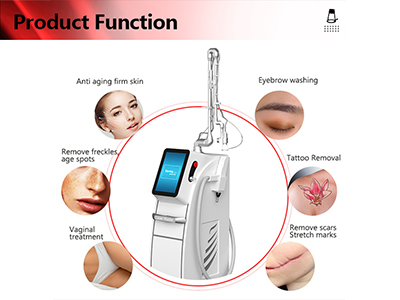
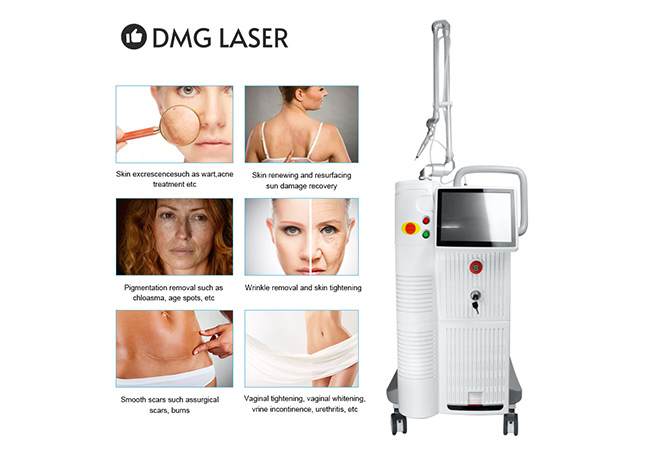
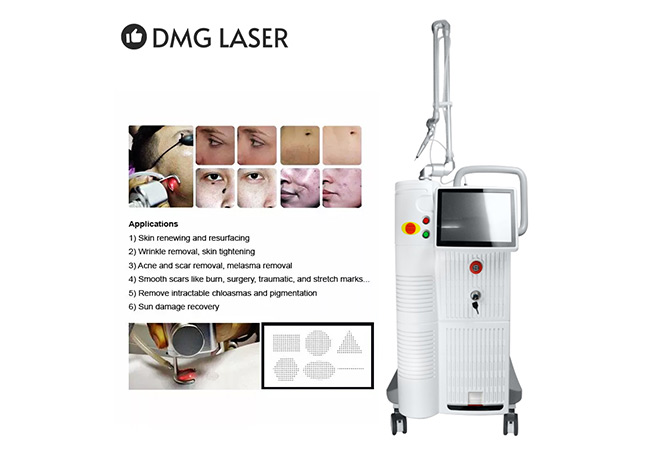
Fractional CO2 lasers are among the most versatile tools in aesthetic medicine. Key indications supported by extensive clinical literature include:
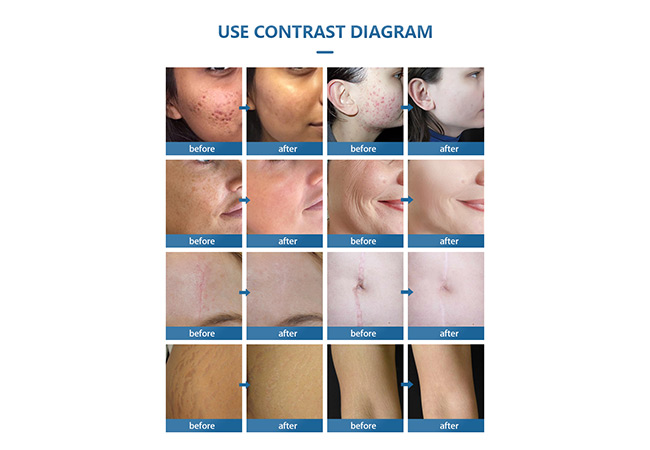
  • Acne scars: Atrophic scars (ice‑pick, boxcar, and rolling types) respond particularly well. Studies report 25–75% improvement over 2–4 sessions, with visible results continuing for months as collagen remodels.
  • Surgical and trauma scars: Hypertrophic and atrophic scars, including burn scars and stretch marks (striae distensae).
  • Photoaging and wrinkles: Perioral and periorbital rhytides, skin laxity, and coarse photodamage.
  • Dyschromia and uneven texture: Solar lentigines, actinic keratoses, and general textural irregularities.
  • Benign lesion removal: Seborrheic keratoses, skin tags, warts, and other superficial lesions (requires a focused surgical handpiece).
  • Gynecological applications: Vaginal rejuvenation and support for genitourinary symptoms (when used with specialized handpieces and in compliance with local regulations).
Clinical studies have consistently demonstrated the efficacy of fractional CO2 lasers. One study reported good to excellent improvement in photodamage in 92% of subjects, with 85% achieving good to excellent reduction in facial rhytides. Another study in Asian patients (Fitzpatrick III–IV) found statistically significant improvements in skin texture, laxity, wrinkles, enlarged pores, and acne scars, with 86% of patients satisfied to very satisfied.

3. Key Advantages for B2B Buyers
3.1 High Return on Investment (ROI)
Fractional CO2 lasers typically deliver full ROI within 6–9 months for a busy medical spa or clinic — significantly faster than older IPL or non‑fractional ablative systems, which often take 12–18 months.
Per‑session pricing for full‑face fractional CO2 treatments in 2026 markets ranges from approximately $800 to $2,500, with averages between $1,000 and $1,500. At just two sessions per week, a clinic can recover its equipment investment in as little as 2–4 months. Consumable costs remain exceptionally low — often under $2.50 per treatment when using long‑life handpieces rated for 800,000 to 1.2 million shots.

3.2 Low Per‑Patient Consumable Cost
Unlike RF microneedling devices that require disposable tips costing $30–$80 per patient, properly maintained fractional CO2 systems have almost no per‑patient consumable cost. The primary recurring expenses are annual calibration, protective lenses, and routine preventive maintenance — typically $1,500–$3,000 per year for a moderate‑volume clinic.

3.3 Fast Patient Turnover
Modern fractional CO2 systems reduce treatment time to 10–20 minutes for a full face, down from 30–45 minutes for older units. Shorter session times allow clinics to schedule more patients per day, directly increasing revenue without adding staff.

4. How to Choose the Right Fractional CO2 Laser Machine
4.1 Laser Source: RF Metal Tube vs. Glass Tube
This is the single most important hardware decision affecting long‑term cost and clinical consistency.
Feature RF Metal Tube (Medical Grade) Glass Tube (Entry/Consumer Grade)
Rated lifespan 15,000–20,000+ hours 1,500–2,000 hours
Beam stability High, consistent output Degrades over time, output drifts
Replacement cost $1,500–3,000 per unit $800–1,500 per unit
Replacements over 5 years (moderate use) 0–1 5–7
5‑year tube cost $0–3,000 $4,000–10,000+
A $2,500 glass‑tube unit easily costs $12,500+ over five years once tube replacements, downtime, and inconsistent results are factored in. A $5,500 RF metal‑tube system with zero tube replacements stays at $5,500.
4.2 Scanning System
A high‑quality galvanometric (Galvo) scanner with adjustable density and pattern shapes (square, circle, hexagon, triangle, custom) is essential. Look for:
  • Randomized scanning patterns — critical for safe darker‑skin protocols
  • Adjustable density — typically 0.1–2.0 mm dot pitch
  • Adjustable depth — multiple handpiece tips covering ultra‑ablative through non‑ablative ranges
4.3 Pulse Width Control
Wider pulse‑width range (0.1–10 ms) gives operators greater flexibility: short pulses for clean ablation (surface texture), longer pulses for deeper coagulation (collagen contraction, scar remodeling).

4.4 Articulated Arm Quality
A 7‑joint Korean or German precision optics arm with documented optical‑path deviation below 0.5% ensures consistent energy delivery across all treatment angles and reduces long‑term calibration drift.

4.5 Cooling System
Integrated cooling (sapphire contact cooling at 0°C to +5°C, or forced air with temperature sensors) protects the epidermis, reduces patient discomfort, and minimizes the risk of burns and post‑inflammatory hyperpigmentation (PIH).

5. Safety Considerations for Fitzpatrick III–VI Skin Types
This is an under‑discussed but critical procurement criterion. Darker skin types (Fitzpatrick III–VI) have a higher risk of post‑inflammatory hyperpigmentation following fractional CO2 resurfacing. Clinical literature reports that up to 92% of patients with Fitzpatrick skin type IV and higher can develop PIH after ablative CO2 laser treatment, making PIH the rate‑limiting factor for using CO2 lasers in higher Fitzpatrick skin types.
This does not mean fractional CO2 lasers are unsafe for darker skin — but proper protocols and device features are essential:
  • Randomized scanning patterns reduce bulk heat accumulation in any one region.
  • Adjustable density and depth allow operators to use conservative settings (lower fluence, lower coverage density).
  • Pre‑treatment with tyrosinase inhibitors (hydroquinone 4%, kojic acid, or equivalents) for 4–6 weeks before treatment.
  • Post‑treatment strict sun protection (SPF 50+, avoid UV exposure for at least 3 months).
When these safeguards are followed, fractional CO2 lasers can be used safely and effectively on Fitzpatrick III–VI patients. Some manufacturers, like Fotromed with their CeloLaser CO2 series, specifically engineer systems with randomized scanning and adjustable parameters to support mixed‑skin‑type clinical practice — a genuine deciding factor in markets such as Latin America, the Middle East, South Asia, and Southeast Asia.

6. Technical Specifications at a Glance
Parameter Value / Range
Wavelength 10,600 nm (10.6 µm) — far‑infrared, strongly absorbed by tissue water
Laser tube type RF‑excited metal tube (medical grade) or DC‑excited glass tube (consumer grade)
Output power (clinical systems) 30–60 W (40 W is the clinical standard)
Spot size (focal diameter) 0.07–0.12 mm (RF metal); ~0.25 mm (glass tube)
Pulse width range 0.1–10 ms
Dot pitch (density) 0.1–2.0 mm
Treatment coverage per pass 5–30% of skin surface (fractional mode)
Cooling Sapphire contact cooling (0°C to +5°C) or forced air with temperature sensors
Duty cycle 2 hours continuous, up to 12 hours/day
Regulatory FDA 510(k) clearance (US), CE marking (EU), ISO 13485

7. Price Tiers in 2026
The market spans roughly $4,500 to over $150,000 for systems that meet medical‑grade baselines.
Tier Price Range (USD) Typical Features
B2B direct (entry medical‑grade) $4,500–8,000 RF metal tube, FDA 510(k) or CE, Galvo scanner, multiple handpieces, training included
Mid‑tier (distributor channel) $20,000–50,000 Established brand, distributor support, longer warranty, more extensive presets
Premium (global brands) $60,000–150,000+ Major brand names (Lumenis, Candela, DEKA), extensive clinical literature, local service networks
Important: Acquisition price is only part of total cost of ownership. A $5,500 RF metal‑tube system with zero tube replacements over 5–10 years often costs less to own than a $2,500 glass‑tube unit requiring 5–7 replacements over the same period.

8. Realistic ROI Calculation
Assumptions (conservative):
  • Equipment cost: $5,500 (medical‑grade, RF metal tube, FDA cleared)
  • Average revenue per full‑face fractional CO2 session: $1,000–1,500
  • Per‑session consumable cost: <$50
  • Net contribution per session at $1,000: ~$950
  • Sessions per week: 3–5
Break‑even calculation:
  • Sessions to recover equipment: $5,500 ÷ $950 ≈ 6 sessions
  • At 3 sessions per week: payback in ~2 weeks
  • At 5 sessions per week: payback in ~8 days
Monthly revenue scenario (5 sessions/week):
  • 20 sessions × $1,000 = $20,000 gross monthly revenue
  • Subtract labor, rent, consumables, overhead (approx. 40%) → $12,000 monthly net profit
For perspective, a premium‑channel system at $60,000 would require roughly 63 sessions to break even at the same per‑session contribution — about 3–4 months at the same throughput. Both can be profitable; the entry‑tier medical‑grade option simply carries far less cash‑flow risk during the patient‑acquisition ramp‑up phase.

9. Procurement Checklist (What to Ask Before Signing)
Before placing an order, obtain written answers to these questions:
  1. Regulatory status: FDA 510(k) clearance number or CE certificate (full document, not a logo). Confirm specific cleared indications.
  2. Laser source type: RF metal tube or glass tube? Rated lifespan in hours. Replacement cost.
  3. Scanning system: Galvanometric (Galvo) or older rotating‑prism system? Random pattern available?
  4. Pulse width range: 0.1–10 ms (full spec, not marketing language).
  5. Spot size at focal point: <0.12 mm for fine fractional work (RF metal tube standard).
  6. Handpieces and tips included: How many? Which depths? Are vaginal or surgical handpieces separate SKUs?
  7. Cooling system: Sapphire contact, forced air, or cryogen? Temperature range.
  8. Warranty terms: Duration, what is covered (tube, scanner, arm, handpieces), response time.
  9. Training included: On‑site or online? Certification provided?
  10. Lead time: From purchase order to delivery. Who handles customs clearance?
  11. Service network: Local contact or remote support? Typical response time for parts replacement.
A supplier that answers all of these in writing without hedging is worth buying from. A supplier that deflects on any is likely to become a problem in month 14.

10. Fotromed CeloLaser CO2 Series – A B2B Direct Medical‑Grade Example
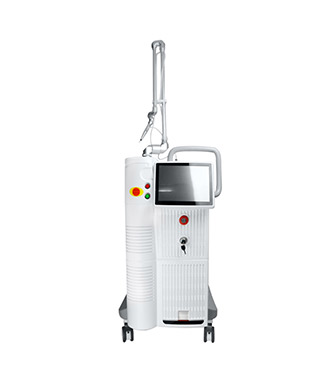
The Fotromed CeloLaser CO2 series illustrates the B2B direct‑sourcing model for medical‑grade fractional CO2 lasers. Key specifications include:
  • Laser source: American Coherent metal RF laser tube — 40W high‑power output, rated up to 20,000 hours (5–10 years of normal clinical use).
  • Wavelength: 10,600 nm fractional CO2.
  • Spot size: Ultra‑fine at 0.07 mm — three times finer than typical glass‑tube systems for more precise, controlled treatments.
  • Scanning: Advanced galvanometric scanning system for accurate, even energy distribution and randomized pattern capability.
  • Duty cycle: 2 hours continuous, up to 12 hours per day — engineered for busy clinical environments.
  • Handpieces: Multiple configurations — fractional resurfacing, surgical cutting, vaginal rejuvenation.
  • Certifications: FDA 510(k) cleared, CE marked, ISO 13485 certified.
  • Applications: Acne scars, surgical scars, photoaging, fine lines and wrinkles, dyschromia, benign lesion removal, vaginal health support.
The CeloLaser CO2 series is available in multiple configurations — the full‑size CeloLaser CO2 (40W, 7‑joint Korean articulated arm, four interchangeable scan tips from Ultra Ablative to Ultra Non‑Ablative) and the compact CeloLaser Compact for clinics with limited space.
South African clinic Pure Skin Middelburg recently upgraded to the Fotromed CeloLaser CO2, reporting that it allows their practitioners to offer more focused treatment options for clients concerned with rough texture, acne scar appearance, enlarged pores, fine lines, and uneven tone.

11. Future Outlook
The global CO2 medical laser systems market was estimated at $509.5 million in 2025 and is projected to reach $933.3 million by 2032, growing at a CAGR of 9.0%. Key trends include:
  • Increasing preference for minimally invasive procedures
  • Rising demand for aesthetic treatments across all age groups
  • Technological enhancements integrating AI and real‑time monitoring for improved precision
  • Development of portable and cost‑effective devices expanding access to smaller clinics
Fractional CO2 lasers are not a fading technology — they are evolving. The gap between premium imported systems and well‑engineered B2B direct medical‑grade devices is narrowing, giving clinic owners more high‑value options than ever before.

12. Summary and Recommendations
For clinic owners and medspa operators:
  • Fractional CO2 lasers remain the gold standard for deep resurfacing, scar revision, and wrinkle treatment.
  • RF metal tube systems provide lower total cost of ownership than glass tube systems despite higher initial price.
  • B2B direct sourcing from manufacturers with FDA/CE clearance offers medical‑grade quality at $5,000–8,000 — a fraction of premium brand prices.
  • Prioritize randomized scanning and adjustable parameters if you serve diverse skin types (Fitzpatrick III–VI).
  • Verify regulatory documentation in writing before payment.
For distributors:
  • Fractional CO2 lasers represent a high‑demand, recurring‑revenue category with strong clinic retention.
  • Partner with manufacturers that offer OEM/ODM customization, training, and reliable after‑sales support.
The right fractional CO2 laser is not an expense — it is a 7–10 year investment in clinical excellence and practice growth. Ask the hard questions before you buy, validate the components that matter, and choose a supplier that treats you as a long‑term partner, not a one‑time transaction.Contact us for a discounted quote on the machine.Whatsapp: +86 19937136112

 
More news
How can we help?
Get in touch with us today for any service. We will reply you within 2 hours